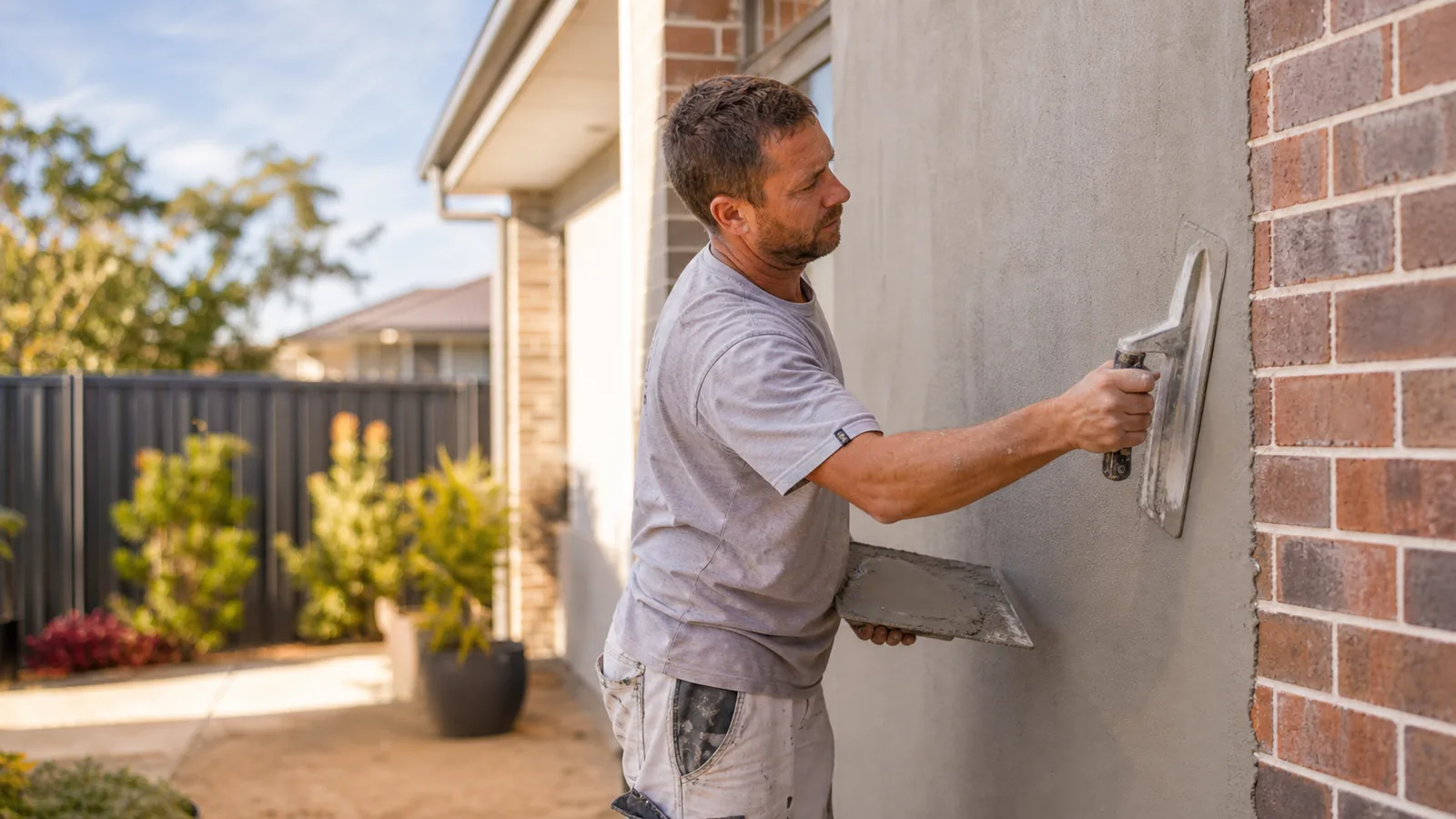
Decide whether the brick pattern belongs in the result
The useful starting question is whether you dislike the brick colour, the brick pattern, or both. A bagged appearance can soften colour and texture while leaving the rhythm of the bricks visible. A fuller render build-up can create a more continuous wall face. Those are different outcomes. Choosing from a small colour chip before deciding which outcome you want can lead to a finish that is technically as quoted but visually disappointing.
Stand where you normally see the house: at the gate, on the driveway and near the entrance. Notice whether the mortar lines add a scale you enjoy or make the facade feel busy. Look at brick piers, window surrounds and projecting courses separately. You may want to retain detail around the entrance while simplifying a larger wall. A whole-house instruction is not always the best way to describe that preference.
In Bendigo, a renovation may need to relate to existing brick, a later garage and a newer front fence. Rather than assuming one finish should cover all of them, identify the element you want to become less prominent. A heavily patterned garage wall and an attractive brick porch may deserve different treatment. Use photographs of your own property with the proposed areas marked, so the discussion stays connected to its actual proportions.
If the wall has heritage significance or may be affected by an overlay, check that before experimenting with a permanent coating. The City of Greater Bendigo Heritage Design Guidelines advise retaining unpainted brick, render and stone without painting. Ask council how the guidance applies to the property and proposed change. A bagged finish should not be assumed acceptable simply because some brick relief remains visible.
Make sure the quote and sample mean the same thing
“Bagged brick” is used loosely in renovation conversations. It may describe a traditional applied finish or the appearance produced by a proprietary texture product. “Light render”, “slurry finish” and “textured paint” can also be used without a shared definition. Before comparing quotes, ask each contractor to name the products, preparation and expected appearance. A finish name alone does not tell you how much of the mortar pattern will remain.
For example, Rockcote Santini is described by its manufacturer as an acrylic product producing a bagged finish using a sponge or mitt. That is a specific product and application, not a universal recipe for every bagged wall. Ask the renderer to show the proposed system's data and a sample of the intended effect on a comparable surface.
Full render also needs a clear description. The quote should explain whether the contractor is building a flatter face, retaining some irregularity, or applying texture over an existing level surface. If your goal is to remove the visible grid of mortar joints, say so directly. Ask whether the proposed build-up and preparation are designed to achieve that result on your wall, including any deeply recessed or uneven joints.
Do not compare material names as though they were finished appearances. Two systems can use different products and arrive at a similar visual effect; two applications of a broadly similar product can look quite different. The useful comparison is the prepared wall, the sample appearance and the written scope. Keep the accepted sample as the reference for the project rather than relying on the wording of a sales brochure.
| Your visual priority | Option to examine | Question for the sample |
|---|---|---|
| Keep the brick rhythm | A bagged or relief-retaining finish | How strongly do the mortar joints show? |
| Create a continuous face | A levelling render system | Are the joints and old patches still visible? |
| Change colour only | A suitable coating approach | Does the existing brick texture still suit the house? |
The existing brickwork sets the preparation task
Examine the mortar as carefully as the bricks. Deeply recessed joints, proud patches and missing mortar can create different effects beneath a thin finish. Ask whether the quote includes correcting those areas or intentionally leaving their relief visible. If one elevation has been repaired with different brickwork, include it in the sample discussion. A finish that looks consistent over the original wall may reveal the repaired section differently.
Painted brick is a separate preparation question. A finish applied over paint depends on the condition and suitability of what remains underneath. Tell the renderer about peeling areas, earlier coatings and any attempts to strip them. Our painted-brick guide covers that decision in more detail. Do not assume that a thinner bagged appearance avoids the need to assess the existing coating.
Also identify damp patches, deposits, crumbling surfaces and recurring cracks before choosing a decorative effect. A new finish can make inspection harder if it covers the signs without resolving the cause. Ask the contractor which areas need investigation before the appearance work can be specified. A product brochure showing an attractive wall is not an assessment of the condition of your own masonry.
Preparation should follow the selected system. The Rockcote systems guide distinguishes preparation and coating sequences for different substrates and finishes. Ask for the specification relevant to your brickwork rather than borrowing a mix or sequence from an unrelated wall. This is particularly useful when the house contains a mixture of bare brick, old render and previously painted areas.
Compare the finishes on the features that matter
Place the comparison where it can include both brick faces and mortar joints. A sample applied to a smooth board can show colour and some texture, but cannot tell you how your existing brick relief will read through the finish. Ask how a representative trial can be made without leaving an unwanted permanent feature. Agree its location and eventual treatment before authorising it.
Include a repaired area in the comparison if repairs are widespread. The most uniform section of brickwork may give an unrealistically favourable impression. Look at the sample across a joint, near a corner and beside a window return where possible. These are places where the difference between retained relief and a flatter rendered face becomes easier to understand.
Assess colour with the roof, frames and paving in view. A pale textured finish can appear different beside a dark window frame than it does on a separate sample held indoors. You do not need to decide every garden detail before rendering, but identify which fixed materials will remain. If the garage door or front fence is also changing, bring those selections into the discussion before final approval.
Ask when the sample is ready to assess and view it in different light. Record what you liked: visible joints, a softer brick outline, a particular amount of hand-worked variation, or a more uniform plane. That description is more useful than “rustic” or “modern”, which can mean different things to different people. Photograph the accepted sample for the record while retaining the actual wall sample as the stronger reference.
Decide how edges and mixed finishes will meet
A bagged wall and a fully rendered wall may need different edge treatments. Discuss how the chosen finish returns into windows, ends against face brick and meets a projecting sill. A finish that looks appealing across the broad wall can feel unfinished if it fades out unpredictably around openings. Ask for the stopping line to be shown before work begins, especially where only part of the facade is changing.
Consider corners from both directions. If the front is treated and the side remains brick, decide whether the finish turns the corner or stops at it. Walk along the side path to judge that boundary. The front-only rendering guide explores this in more detail. There is no need to coat every side wall to achieve a deliberate frontage, but the junction should look intentional.
Keep useful original features in the discussion. A contrasting brick band, a recessed porch or a shaped pier may be something you want to preserve rather than flatten. Ask whether the proposed preparation would alter those features. A digital colour mock-up can help compare broad areas, but it may not show the depth and shadow of the actual brickwork. Use it to select boundaries, then confirm the physical finish with a sample.
At handover, keep records of the final system and application effect. A later patch on a hand-worked surface may need a sample of its own, even when the same product is still available. Tell anyone attaching fixtures to the wall what the surface is and how repairs should be discussed. Good records will not guarantee invisible future work, but they make the conversation more specific.
Questions about bagging and full render
Is bagging simply a cheaper version of rendering?
It is better treated as a different appearance. Preparation, access and the condition of the wall still influence the scope. Ask for comparable quotes with the same areas and preparation, then decide whether you prefer visible brick relief or a flatter face. A lower price does not make a finish suitable if it leaves the pattern you wanted to remove.
Can I keep some of the original brick colour visible?
Describe that intention carefully and ask for a sample. An uneven or translucent effect is a different brief from a fully coloured bagged appearance. The selected product and technique need to support the desired result. Do not assume the renderer will interpret a reference photograph the same way you do without discussing the amount of coverage.
Will bagging hide a wall built from mismatched bricks?
It may reduce colour differences, but differences in shape, joint depth and repairs can remain apparent. Show the contractor the least consistent part of the wall and include it in the trial. If your main objective is a uniform plane, ask how the bagged option compares with a levelling render rather than judging only the colour.
Can a bagged wall be changed to a smoother finish later?
A future change needs assessment of the existing system, adhesion and condition. Do not choose the first finish on the assumption that it can always be covered cheaply. Ask what preparation a later change might involve and keep the product records. Choose the appearance you expect to live with, using a sample to resolve uncertainty now.